

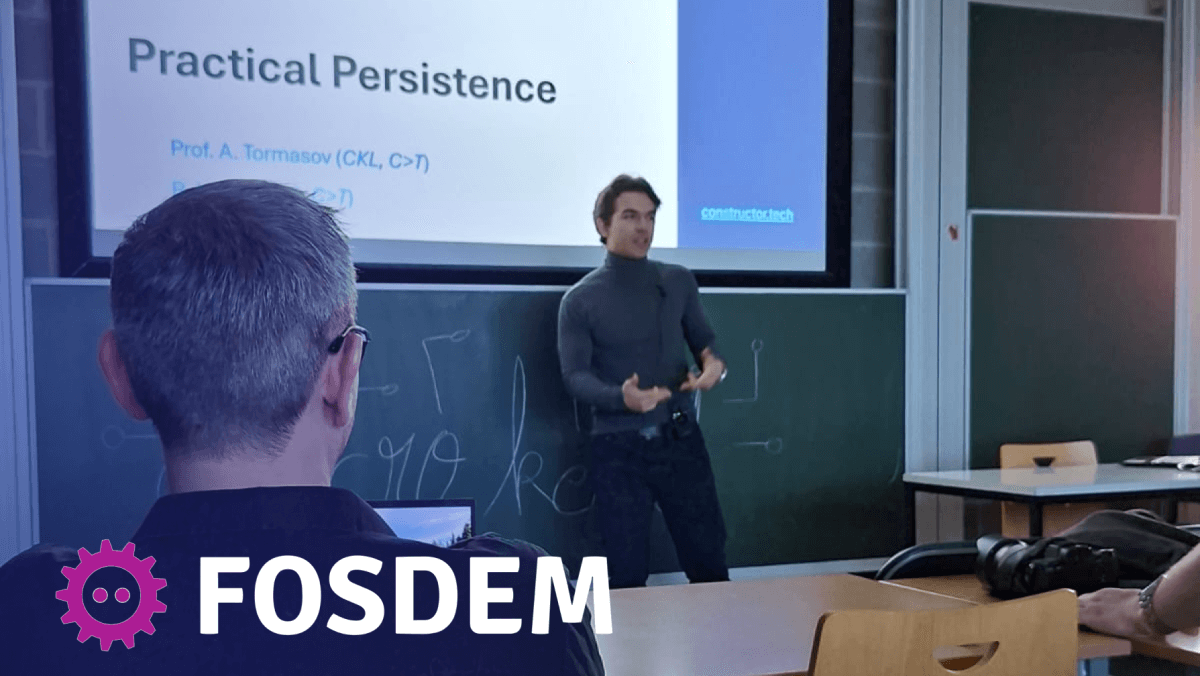
Held in Brussels, FOSDEM is a long-established meeting point for the open-source community, known for its rigorously technical tracks covering operating systems, programming languages, developer tooling, infrastructure, security, and experimental systems research. It provides a setting where theoretical work is examined through the lens of real system constraints.
At FOSDEM 2026, our team presented PhantomOS, an academic research project investigating orthogonal persistence in operating system design. PhantomOS enables programs to resume execution precisely from their last state following shutdowns or crashes — an architectural approach aimed at improving system continuity and computational efficiency.
The presentation focused on the concrete implementation of PhantomOS on a modern microkernel architecture using the Genode framework, with particular attention to the redesign of the snapshot mechanism and the introduction of storage recovery via integration with the ext4 file system. These engineering decisions address practical obstacles encountered when adapting persistent operating system models to contemporary platforms.
The project was represented by:
- Alexander Tormasov, Chief Research Officer – providing academic supervision and shaping the project’s research methodology
- Rumen Mitov, Research / Software Engineering Intern – leading the implementation work and delivering the technical presentation
We’re proud to support research that links theoretical computer science with system-level engineering. The interest and constructive discussion at FOSDEM underscore the relevance of sustained research into operating system architecture and its implications for future software systems.
As PhantomOS continues to develop, we look forward to further exploration of orthogonal persistence and its potential impact on the design of dependable, state-preserving computing environments.