

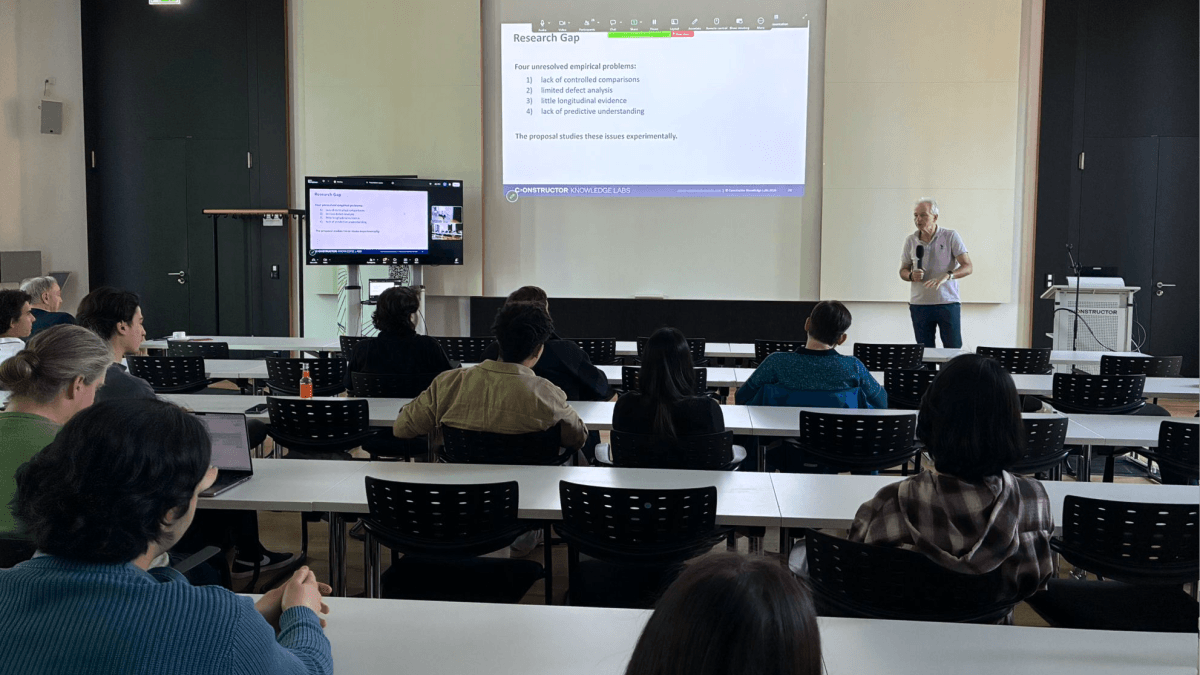
This Wednesday, we brought together 50+ participants for the 2nd session of the CKL/CSE Seminar Series and the discussion turned out to be genuinely thought-provoking.
Prof. Dr. Andreas Birk walked us through the problem of robust registration as a foundational challenge in machine perception, framing it as the task of spatially aligning partial 2D or 3D views of a scene under noise, occlusion, and dynamic conditions where conventional feature-based methods consistently break down. He presented two families of alternative approaches: surface-based representations using plane fitting and superquadric modeling, and frequency-domain methods built on the SO(3) Fourier Transform with spherical harmonics, achieving efficient 6-DOF correlation. These were grounded in concrete deployments ranging from underwater mapping with scanning sonars to radar-based multi-object tracking in high-velocity autonomous racing, pursued under the DFG project “Tracking of Highly Dynamic Objects.”
Prof. Dr. Giancarlo Succi picked up from there and brought the conversation into software engineering, presenting his DFG proposal AGENTS, an empirical study of how autonomous agent strategies perform on the long-standing problem of software integration. He argued that while LLM-based code generation has advanced rapidly, no study has yet compared non-agentic baselines, single-agent, and multi-agent strategies under controlled heterogeneous integration benchmarks with longitudinal evaluation, leaving reliability, defect behavior, and maintenance properties largely uncharacterized. The proposed project addresses this through four work packages progressing from benchmark construction and controlled comparison to evolution analysis and predictive modeling, with integration tasks formally represented as tuples capturing source components, target environments, mismatch classes, and evolution event sequences. Statistical inference relies on mixed-effects and repeated-measures models, with predictive modeling via random forests and gradient boosting evaluated through cross-validation, and all confirmatory hypotheses fixed prior to experimentation.
What stayed with us after the session:
- Frequency-domain registration via SO(3) Fourier transforms provides robustness where all feature-based methods break down, making it a genuine foundation for machine perception across radically different sensing modalities.
- No controlled empirical study has yet compared non-agentic, single-agent, and multi-agent integration strategies under heterogeneous benchmarks with longitudinal evaluation – and until that evidence exists, claims about autonomous software engineering remain scientifically premature.
- Confirmatory hypotheses must be fixed before experimentation begins, integration tasks must be formally specified across mismatch classes and evolution sequences, and negative results carry equal scientific weight. These are the standards that rigorous empirical software engineering demands.
Thanks to everyone who joined us! Looking forward to the next session.